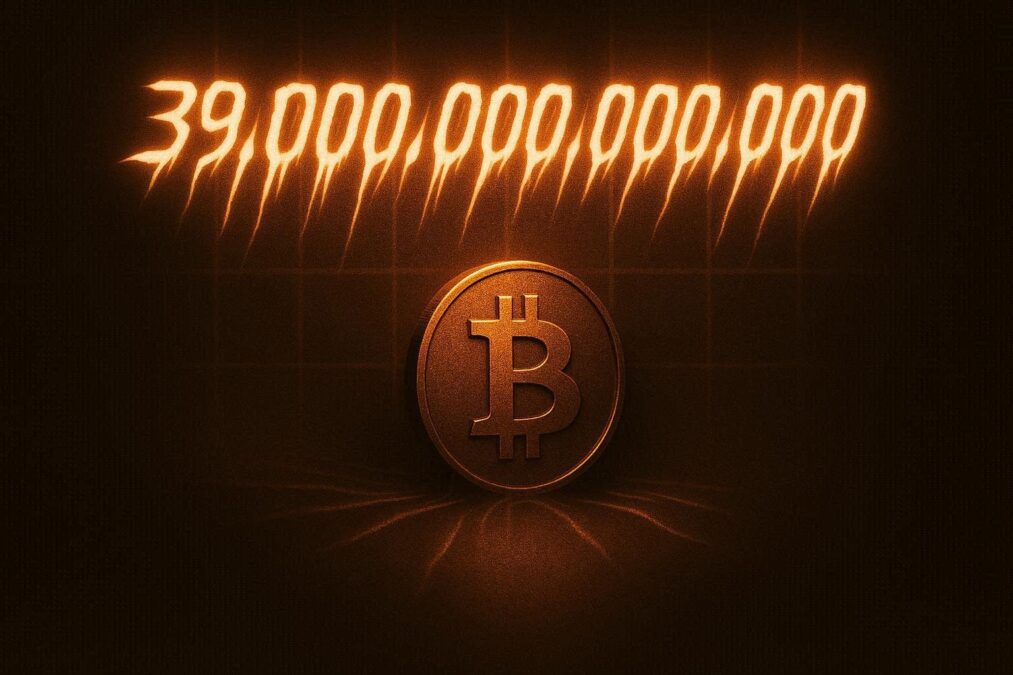
Welcome back to the reality check. If you’ve been watching the news lately, you’ve seen the headlines celebrating “economic resilience” and “soft landings” while conveniently ignoring the $39 trillion elephant in the room. Yes, as of mid-2026, the US national debt has officially crossed that eye-watering milestone. To put that in perspective for the “fiat-brained” individuals out there: that is roughly $117,000 of debt for every single citizen. Congratulations, you’re born into a hole you didn’t dig, and the government is still handing out shovels.
The Debt Spiral is No Longer Theoretical
For years, the so-called “experts” in ivory towers told us that debt doesn’t matter as long as we can service the interest. They treated the national ledger like a magical scroll where numbers could be added indefinitely without consequence. Well, welcome to 2026, where the “bitter” reality has finally caught up. We have entered the “Debt Spiral” phase of the experiment. This is the point where the interest payments on the existing debt have become one of the largest line items in the federal budget, rivaling national defense.
Think about that for a second. We aren’t even paying back the principal; we are just paying for the privilege of being in debt. When a country has to borrow money just to pay the interest on the money it already borrowed, you aren’t looking at a global superpower; you’re looking at a Ponzi scheme with a flag and a nuclear arsenal. The system is cannibalizing itself, and the only fuel it has left is your purchasing power.
The Three Doors of Economic Failure
The truth that politicians won’t tell you on a Sunday morning talk show is that there are only three ways out of a $39 trillion hole, and none of them are “sweet.”
Door Number One: Default. This is the honest route. The government admits it can’t pay, the debt is wiped, and the global financial system collapses overnight. They won’t choose this because it kills the machine that keeps them in power.
Door Number Two: Austerity. This means cutting spending, raising taxes, and actually living within our means. In a world of 24-hour news cycles and populist movements, austerity is political suicide. No politician is going to tell a coddled electorate that the party is over. So, they leave that door locked.
Door Number Three: Inflation. This is the coward’s exit, and it’s the one they’ve already chosen. Inflation is a silent, invisible tax. It doesn’t require a vote in Congress. They simply print the money, dilute the supply, and pay off the debts of the past with the “cheaper,” devalued money of the future. While you celebrate a 3% raise at work, the cost of the “Standard of Living” has risen by 10%. You are running faster and faster on a treadmill that is slowly being tilted upward.
The CBDC “Solution”: Your Money, Their Remote Control
As the legacy fiat system cracks under the weight of its own incompetence, the architects of this mess are unveiling their “upgrade”: Central Bank Digital Currencies (CBDCs). By now, in 2026, you’ve seen the pilot programs and the glossy advertisements promising a “frictionless digital future.” Don’t be fooled by the marketing. A CBDC is not Bitcoin’s younger, more responsible brother. It is a wolf in digital sheep’s clothing.
Unlike Bitcoin, which is permissionless, decentralized, and pseudonymous, a CBDC is the ultimate tool of financial surveillance. It gives the state a front-row seat to every transaction you make—from the coffee you bought this morning to the charity you supported last night. But it’s worse than just surveillance; it’s programmability.
Imagine a world where your “money” has an expiration date to “stimulate the economy.” Imagine your digital wallet being throttled because you purchased too much “high-carbon” meat this month, or your ability to travel being restricted because your “social credit” took a dip. A CBDC is fiat 2.0, but with a “kill switch” attached to your life’s work. It is the end of financial privacy and the beginning of absolute state paternalism.
The Authority of the 21 Million
This brings us back to why we are here. Bitcoin isn’t just a speculative asset for people who like charts and neon colors. It is the only logical exit strategy. While the US debt clock ticks at a rate of over $500 per second, the Bitcoin supply remains stubbornly, beautifully, and predictably fixed.
There will only ever be 21 million. No committee can vote to change it. No president can issue an executive order to “print more” Bitcoin to fund a foreign war or a domestic bailout. Bitcoin is the first time in human history that we have a money that is completely decoupled from the whims of the ruling class. It replaces “Full Faith and Credit” with “Verify, Don’t Trust.”
In a world of infinite debt, the only thing that has true, lasting value is the thing that is finite. Bitcoin is digital scarcity in a world of digital abundance. It is the “Hardest Money” ever discovered because it requires the one thing governments hate most: a connection to physical reality (via Proof of Work) and a limit that cannot be negotiated.
The Lifeboat vs. The Titanic
People often ask, “But what if the government bans Bitcoin?” This is the same government that can’t stop drugs from entering prisons or keep its own budget balanced for a single week. Bitcoin is a protocol—a global, distributed ledger that lives everywhere and nowhere at the same time. Banning Bitcoin is like trying to ban math. You can make it difficult for your citizens to access, but you cannot kill the network.
Every “Sat” you stack is a vote of no confidence in the current regime. It is a declaration of independence from a system that views your savings as a piggy bank for their failures. As we watch the $39 trillion climb toward $40 trillion—which, at the current rate of acceleration, will likely happen before the year is out—the signal has never been clearer.
The “bitter” truth is that the legacy system was never designed to last forever. It was designed to provide a period of artificial prosperity fueled by the theft of future labor. We are the “future” that is being robbed.
Conclusion: Time to Wake Up
The Bitcoin Standard is about more than just “getting rich.” It’s about not staying poor. It’s about recognizing that the “Safety” of a bank account is a facade and the “Stability” of the dollar is a hallucination.
The math of $39 trillion in debt is terminal. There is no “fixing” it; there is only surviving the transition. Bitcoin is the lifeboat. It’s not always a smooth ride, and the waves of volatility can be sickening for those who don’t understand the underlying physics. But it’s the only thing that actually floats when the world is drowning in a sea of ink and broken promises.
So, keep your eyes on the debt clock. Let it be the reminder you need every morning. While the rest of the world is busy arguing over which flavor of fiat-flavored poison they prefer, we’ll be over here, securing our keys and watching the hallucination dissolve.
Stay bitter, stay sovereign, and for the love of Satoshi, get your coins off the exchanges. The 21 million ceiling is the only thing standing between you and the $39 trillion floor.