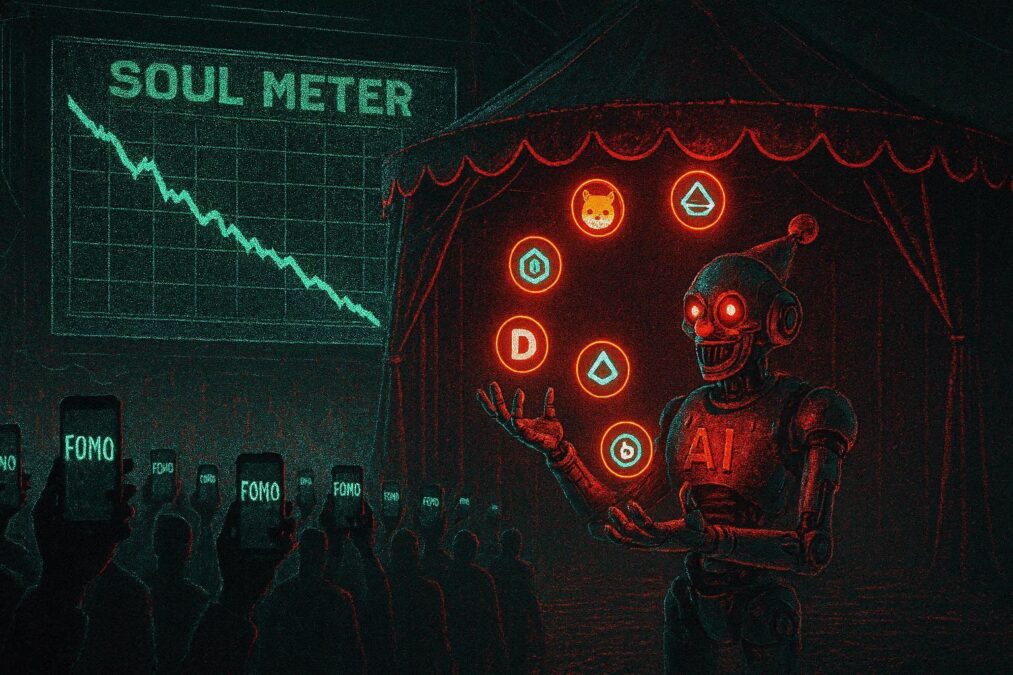
If you’ve been hanging out in the Moonshot Coins Circus or tinkering in the DeFi Lab, it’s easy to get the impression that crypto is just a high-stakes video game played with digital tokens that have names like “FARTCOIN” or “PIPPIN.” You’d be forgiven for thinking that the entire industry is just a bunch of people in hoodies trying to sell each other “magic beans” while Jerome Powell tries to stop the US National Debt from hitting the moon before Bitcoin does.
But as of May 2026, something has shifted. The “Invisible Crypto” era has arrived.
While the degens are chasing 100x gains on the latest AI-agent-led meme, a much quieter revolution is happening in the grocery store, at the lawyer’s office, and on the factory floor. Crypto is finally losing its “crypto-ness” and becoming just another layer of the world’s plumbing.
Today, we’re stepping out of the trading pits and into the street. Let’s look at how the tech we’ve been “grilling” in the lab is actually showing up in your real life.
1. The Stablecoin “Invisible Rail”
The most significant real-world use case for crypto in 2026 isn’t Bitcoin—it’s the Digital Dollar. Stablecoins like USDC and PYUSD have become the “shadow infrastructure” for global commerce.
Remember when “sending money home” meant a 7% fee and a three-day wait at a Western Union? In 2026, stablecoin remittances are the norm. Thanks to integrations between companies like Stripe, Mastercard, and the Stellar network, a migrant worker in Miami can send USDC to their family in Brazil or the Philippines instantly.
The best part? The family doesn’t even know they’re using “crypto.” They see a balance in their digital wallet, hit “Withdraw,” and pick up local cash at a participating local branch. The blockchain is just the rail—the same way you don’t think about TCP/IP when you send an email.
Real World Stat: In early 2026, stablecoin transaction volume has surged, but nearly 15% of it is now tied to “Non-Crypto” economic activity—paying suppliers, settled checkouts, and cross-border payroll.
2. Tokenized Real Estate: Owning the Block, Not Just the Coin
Real estate has always been the ultimate “Old School” asset—slow, expensive, and buried in paperwork. But in 2026, Real World Asset (RWA) Tokenization has finally broken the door down.
In markets like Brazil and Argentina, we’re seeing the first regulated exchanges for tokenized property. Instead of needing $500,000 to buy a commercial office space, you can buy a $1,000 “token” that represents fractional ownership of that building.
This isn’t just “buying a coin that follows the price of houses.” It’s legal ownership.
- The Rent: The monthly rent from the building is automatically distributed to token holders’ wallets in stablecoins.
- The Drex Factor: In Brazil, the central bank’s digital currency (Drex) is designed to interact directly with these tokens. When you buy a share of a building, the money and the deed move at the exact same time. No escrow, no 30-day waiting period, and significantly fewer legal fees.
3. DePIN: The People’s Infrastructure
If you haven’t heard of DePIN (Decentralized Physical Infrastructure Networks), you will by the end of 2026. This is where crypto actually builds physical things.
Think of it like Airbnb, but for the internet.
- Helium & 5G: People are setting up 5G nodes in their windows and getting paid in tokens to provide cell coverage to their neighborhood.
- Hivemapper: Drivers are mounting specialized dashcams on their cars to map the world in high-definition, earning rewards for providing data that rivals Google Maps.
- Render Network: Your neighbor might be using their high-end gaming PC to help a movie studio in Hollywood render special effects while they sleep, getting paid in RNDR tokens.
DePIN is turning “crypto rewards” into a way to fund the world’s hardware. It’s no longer about a bot selling beans; it’s about a teenager in a rural town earning enough crypto to pay their phone bill just by letting a small box sit on their roof.
4. The End of the “Fake” Luxury Bag
Supply chain transparency has been a “coming soon” feature of blockchain for a decade. In 2026, the luxury industry has finally made it mandatory.
Groups like the Aura Blockchain Consortium (LVMH, Prada, Cartier) are now issuing “Digital Passports” for every high-end item. When you buy a Louis Vuitton bag in 2026, it comes with an encrypted NFT (Non-Fungible Token) that acts as its birth certificate.
You can scan the bag with your phone to see:
- Origin: Where the leather was sourced.
- Authenticity: Proof it’s not a high-quality “super-clone” from a counterfeit factory.
- Ownership History: If you buy it second-hand, the “passport” is transferred to your wallet, proving you’re the rightful owner.
This has effectively killed the “shady alleyway” luxury market. If there’s no digital passport, it’s not real.
5. PolitiFi and the 2026 Midterms: Betting on the News
As we approach the 2026 U.S. Midterms, “PolitiFi” (Political Finance) has turned the election into a liquid market. Tokens like $TRUMP and various midterm-themed assets are trading as high-volatility proxies for polling data.
While it looks like gambling, it’s actually a real-time sentiment engine. In an era of fake news and manipulated polls, many analysts are looking at the “On-Chain Odds” to see where people are actually putting their money. It’s a brutal, transparent way to see what a population actually thinks, rather than what they tell a pollster over the phone.
6. The “Seeker” and the Death of the App Store Tax
We’ve talked about the Solana Seeker phone in the Lab, but its real-world impact is about freedom. In 2026, the “30% Apple Tax” is under siege.
Because crypto-native phones allow for direct-to-consumer app distribution, creators are finally keeping 100% of their revenue. Whether it’s a musician selling an album directly to fans as a “Music NFT” or a game developer launching a title that doesn’t need Google Play’s permission, the “Crypto Phone” is the first real crack in the Silicon Valley monopoly.
The Red Flag Checklist: Real World Edition
Just because a project is “Real World” doesn’t mean it’s safe. Before you dive into RWAs or DePIN, ask:
- The Legal Wrapper: If I buy a tokenized house, do I have a legal claim in a real court, or just a promise from a website?
- The Hardware Trap: For DePIN, am I buying a $600 box that will only earn me $0.05 a day? Calculate your ROI before you buy the gear.
- The “Middleman” Check: If a “stablecoin” provider isn’t transparent about their bank reserves, it’s just a digital IOU that could vanish.
The Bottom Line
In 2026, the most successful crypto projects are the ones you stop calling “crypto.”
When you pay for a coffee with a stablecoin-linked debit card, or when you check the provenance of your coffee beans by scanning a QR code on the bag, you’re using the technology we’ve been discussing for years. The “Magic Beans” era hasn’t ended—it just grew up.
The volatility is still here, and the scammers are still lurking in the shadows, but the utility is now undeniable. Crypto is no longer a “potential” future; it’s the quiet engine running the world around you.
How much of your “Real Life” is already on-chain? Are you using stablecoins for your business, or are you still waiting for the bank to clear your transfers?
Note: This post is for educational purposes and “backyard barbecue” discussion. It is not financial advice. Always do your own research before putting your hard-earned fiat into the digital void.