
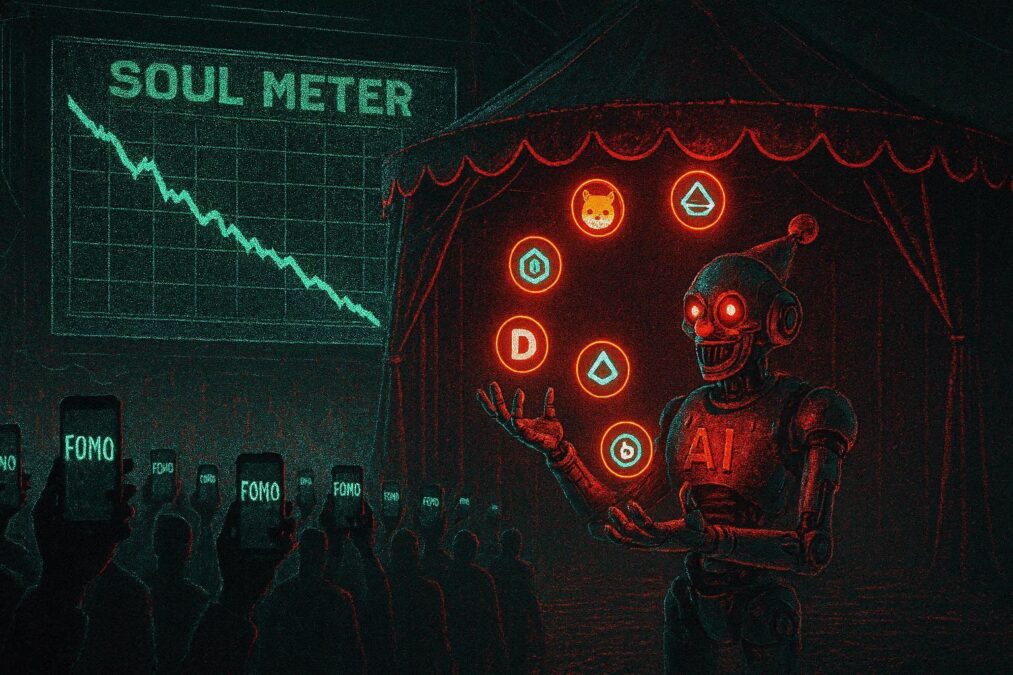
Welcome back to the Moonshot Coins department, otherwise known as the wing of the financial hospital where we keep the patients who still believe in “community-driven” miracles. If you’ve stepped away from the $39 trillion horror show of the US National Debt—which is currently growing at nearly $57,000 per second—you might think a coin named after an AI-generated flatulence joke is a “safe haven”. Spoiler alert: it isn’t.
As of late April 2026, the global economy is a masterclass in absurdity. Jerome Powell is preparing his final exit from the Federal Reserve, the U.S. debt is a vertical line at 137% of GDP, and retail investors are currently losing their collective minds over “autonomous agents”. We’ve officially moved past the era of just buying a dog with a hat. Now, we buy tokens because a chatbot on X told us they have a “soul.” Let’s look at the wreckage of the current trends before your “generational wealth” turns back into a pumpkin.
Table of Contents
- The AI Agent Sovereignty: PIPPIN, FARTCOIN, and the “Sentient” Scam
- Pudgy Penguins (PENGU): From Plushies to the Top 100
- MemeCore (M): The Layer 1 Blockchain for People Who Hate Math
- PolitiFi Mania: TRUMP and the Midterm Election Gambling Den
- The Liquidity Illusion: Why You Can’t Exit When It Matters
- The Psychology of the Exit: Why Everyone Thinks They’re Early
- The Red Flag Checklist: How to Spot a 2026 Rug Pull
1. The AI Agent Sovereignty: PIPPIN, FARTCOIN, and the “Sentient” Scam
The hottest trend dominating X and TikTok right now is the “AI Agent” meta. In the 2024 cycle, you bought a meme because it was funny. In 2026, you buy it because an autonomous bot is running a 24/7 propaganda machine. Leading this automated circus is PIPPIN and FARTCOIN.
PIPPIN is currently trading around $0.026 with a market cap of roughly $26 million. It’s an AI-agent-led token that uses modular frameworks like BabyAGI to simulate a personality. Meanwhile, FARTCOIN—which somehow achieved the #1 position in the AI meme coin rankings—is trading at approximately $0.20 as of late April.
On the surface, this looks like innovation. In reality, it’s just automation applied to hype. Instead of a team manually posting memes, you now have bots generating narratives, replying to users, and creating the illusion of a living ecosystem. The key word here is illusion.
Let’s break down the mechanics:
- The Yield Trap: These “AI” tokens often promise rewards for interacting with the bot—liking posts, engaging in chats, or participating in “missions.”
- A Simple Question: Ask yourself: where does that money come from?
- The Printing Press: If the “yield” is just more of the same token, you’re not earning—you’re being diluted.
- Centralization Reality: Who owns the API keys? Who controls the model?
- The Kill Switch: If the developer pulls the plug, your “autonomous” ecosystem vanishes instantly.
What makes this cycle different is speed. Narratives used to take weeks to build. Now, AI agents can fabricate a cult-like following in hours. That compresses both the upside—and the collapse.
2. Pudgy Penguins (PENGU): From Plushies to the Top 100
If you prefer your Moonshot Coins with a side of physical toys, look at Pudgy Penguins (PENGU). On April 27, 2026, PENGU surged over 17%, hitting a price of $0.010 with a massive $385 million in daily trading volume.
PENGU is the poster child for the “retail pivot.” They’ve managed to place plush toys in major retail stores and generate over 100 billion social media views. On paper, this is exactly what crypto has been trying to achieve: bridging digital assets with real-world presence.
But here’s the uncomfortable truth: attention is not the same as value.
Ranking at #89 globally with a $630 million market cap, the turnover ratio is extremely high. That means the token is being traded constantly—not held. This isn’t a long-term conviction play; it’s a high-speed speculation engine.
There’s also a structural issue that rarely gets discussed:
- Revenue vs Token Value: Selling plushies generates revenue for the company—not necessarily for token holders.
- Brand vs Asset Disconnect: You can have a successful brand and a declining token at the same time.
- Speculative Premium: Most of the token price is based on future expectations, not current utility.
In other words, you might be buying into a great marketing operation—but that doesn’t guarantee financial returns. The market doesn’t reward branding alone; it rewards cash flow, scarcity, and sustained demand.
3. MemeCore (M): The Layer 1 Blockchain for People Who Hate Math
Why just buy a meme coin when you can buy an entire blockchain dedicated to them? MemeCore (M) is the “Layer 1” solution for the degenerate era. Currently trading around $4.35, it recently saw its market cap reach $3.64 billion.
MemeCore aims to be the foundational layer for meme-based digital economies. The pitch is simple: if memes are the future, you need infrastructure to support them. It’s a compelling narrative—until you look under the hood.
The biggest concern is governance and supply distribution:
- Over 80% of the supply is held by a small number of wallets.
- Many of these wallets are contract-controlled, meaning decisions can be automated—or manipulated—without transparency.
- Inflation mechanisms allow continuous token issuance.
This creates a familiar dynamic:
You’re not early—you’re exit liquidity.
Projects like MemeCore often rely on a steady influx of new buyers to sustain price levels. Without that inflow, the system stalls. And when it stalls, large holders have every incentive to sell first.
There’s also the question of necessity. Do meme coins actually need a dedicated Layer 1 blockchain? Or is this just a solution in search of a problem?
In many cases, complexity is used as a smokescreen. The more technical the pitch sounds, the less people question whether it’s needed at all.
4. PolitiFi Mania: TRUMP and the Midterm Election Gambling Den
With the 2026 U.S. midterm elections approaching, the Official Trump (TRUMP) token has become a high-volatility proxy for political sentiment. Trading around $3.01 with a $701 million market cap, it is purely a narrative-driven asset.
PolitiFi tokens represent a new frontier in speculation: betting on attention cycles tied to real-world events.
Here’s what drives these markets:
- News Flow: Headlines act as price catalysts.
- Social Media Momentum: Viral posts can trigger rapid inflows.
- Event Timing: Debates, polls, and announcements create volatility spikes.
But this also introduces unique risks:
- Unpredictability: Political outcomes are inherently uncertain.
- Manipulation: Narratives can be shaped or amplified artificially.
- Short Lifespan: Interest often fades quickly after key events.
Research and past cycles suggest a consistent pattern:
- A major event triggers hype.
- Prices spike rapidly.
- Early participants exit.
- Late entrants absorb the losses.
It’s less an investment and more a timing game. And timing games are notoriously unforgiving.
5. The Liquidity Illusion: Why You Can’t Exit When It Matters
One of the biggest misconceptions in crypto is liquidity. A token can show millions in market cap and daily volume—but that doesn’t mean you can actually sell your position at the listed price.
Liquidity is not what you see on the screen. It’s what’s left after everyone tries to exit at once.
Here’s how the illusion works:
- Thin Order Books: A small number of buy orders supports the price.
- Slippage: Large sells push the price down dramatically.
- Fake Volume: Wash trading inflates activity metrics.
Imagine holding $100,000 worth of a token. On paper, you’re up 10x. But when you try to sell, you discover that there’s only $5,000 of real demand near the current price. The rest collapses as you exit.
This is why many “millionaires” in meme coins never actually realize their gains. The exit door is much smaller than the entry door.
6. The Psychology of the Exit: Why Everyone Thinks They’re Early
Every cycle has one defining belief: “I’m still early.”
In 2026, that belief is reinforced by algorithmic feeds, AI-generated narratives, and constant exposure to success stories. You see screenshots of 100x gains, viral threads, and influencers claiming this is just the beginning.
What you don’t see:
- The thousands of failed tokens.
- The wallets that bought the top.
- The insiders who entered before the narrative existed.
This creates a distorted perception of reality.
Humans are wired to chase momentum. When prices go up, it feels like validation. When others profit, it feels like opportunity. But markets don’t reward emotions—they exploit them.
By the time a token is trending on TikTok, it’s rarely early. It’s visible. And visibility is often the signal that early participants are preparing to exit.
7. The Red Flag Checklist: How to Spot a 2026 Rug Pull
Before you chase the next 1000x gain, remember the statistical reality: in April 2026 alone, crypto protocols lost over $606 million to hacks and exploits.
Here’s a practical checklist:
- Liquidity Scrutiny: Does the trading volume support the market cap?
- Wallet Concentration: Are a few wallets controlling most of the supply?
- Token Utility: Is there a real use case, or just a narrative?
- Development Transparency: Is the team visible and accountable?
- The Bot Mirage: Is the “AI” actually functional, or just branding?
- Exit Mechanisms: Are there lockups, taxes, or restrictions on selling?
If multiple red flags appear, the risk compounds quickly.
The Bottom Line
The Moonshot Coins of 2026 are not fundamentally different from previous cycles—they’re just faster, louder, and more automated. AI didn’t change the game; it accelerated it.
At the same time, the broader financial system continues to strain under unprecedented debt levels. This creates a strange environment where distrust in traditional systems pushes people toward speculative alternatives—often without fully understanding the risks.
That combination is powerful—and dangerous.
Because in the end, the core dynamic remains the same:
- Someone creates a narrative.
- Others buy into it.
- Early participants profit.
- Late participants pay the price.
If you aren’t doing the “Red Flag” check, you’re not investing—you’re participating in a lottery with better marketing.
Stay skeptical. Question everything. And remember: when a chatbot tells you a token has a “soul,” it’s probably just trying to sell you magic beans.