Welcome to the inaugural post of Bitter Crypto. If you were expecting a warm hug and a roadmap to “passive income” via some algorithmic stablecoin, you’ve wandered into the wrong neighborhood. Here, we start with the foundation. And the foundation is currently on fire, even if the central banks are telling you the smoke is just “transitory.”
To understand Bitcoin, you first have to understand the bitter reality of the money you currently keep in your wallet—or, more accurately, the digits your bank allows you to see on a screen. We live in an era of the Great Fiat Hallucination. We have collectively agreed to value pieces of paper (or digital entries) backed by nothing more than the “full faith and credit” of governments that are currently $34 trillion in debt. If a private individual ran their household finances the way a modern nation-state runs its treasury, they wouldn’t just be bankrupt; they’d be in a straitjacket.
The Bittersweet History of Money
Money, at its core, is simply a tool to transport your life’s energy—your time, your sweat, your labor—through time and space. For thousands of years, humans used gold because it was hard to create more of it. It had “unforgeable costliness.” You couldn’t just wish more gold into existence. But gold was heavy, hard to divide, and even harder to send across the ocean in seconds. So, we created paper receipts for gold. Then, in 1971, the world’s superpower decided that the receipts didn’t need the gold anymore.
Since that day, the “bitter” part of our story accelerated. Without the tether of a physical reality, money became a political tool. When a government needs to fund a war, a bridge to nowhere, or a bailout for a bank that gambled away its customers’ deposits, they don’t ask for permission. They don’t even necessarily raise taxes—that’s too unpopular. They just print.
Every time a new dollar, euro, or pound is printed, the value of the currency already in your pocket is diluted. It’s a silent, invisible tax on your time. You worked 40 hours this week to earn a specific amount of “value,” but by next year, that same amount of money buys 10% less food, 15% less housing, and 20% less energy. You are running on a treadmill that is slowly speeding up, and the people at the control panel are laughing.
Why Bitcoin? Because Math is Harder than Politics
This brings us to the Bitcoin thesis. Bitcoin is often called “Digital Gold,” but that’s actually an insult to Bitcoin. Bitcoin is better than gold because you can’t fake it, you can’t print more of it, and you can verify its scarcity from a device in your pocket.
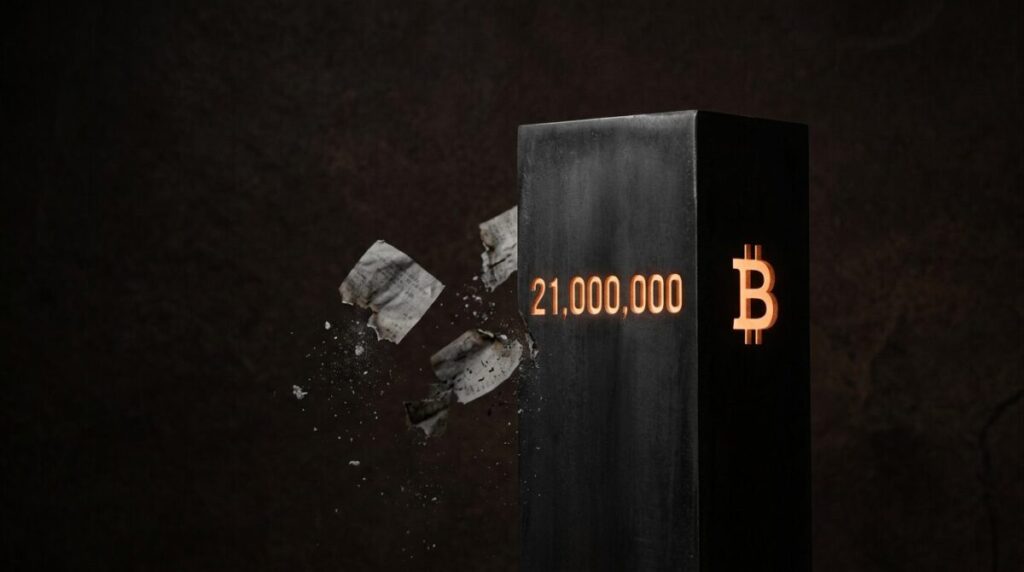
The beauty of Bitcoin is its bitterness toward human intervention. It is a system built on the assumption that humans are greedy, corruptible, and prone to bad decisions when given power. Therefore, Bitcoin removes the humans. It replaces the “Federal Reserve Board” with a line of code that says: 21 Million. No more. Ever.
In a world of infinite printing, the only thing that has true value is the thing that is finite. Bitcoin is the first and only global, decentralized, censorship-resistant, digital-native scarcity. It is the “Hardest Money” ever invented because its supply is decoupled from the whims of a king, a president, or a central banker.
The Store of Value Argument
Critics love to point at the price volatility. “How can it be a store of value if it drops 20% in a weekend?” they ask, while their own currency loses 99% of its purchasing power over a century. Volatility is the price you pay for an asset that is finding its true value in a free market without a “Plunge Protection Team” to prop it up.
Bitcoin isn’t volatile; Bitcoin is a mirror. It reflects the instability of the world around it. When the legacy system shakes, people flee to the only lifeboat that isn’t tethered to the sinking ship. If you measure your wealth in fiat, you’re measuring your height with a shrinking ruler. When you measure it in Bitcoin, the ruler stays the same. One Bitcoin will always be 1/21,000,000th of the total supply. That is the ultimate “Sweet” part of the bittersweet crypto journey: the peace of mind that comes with knowing your wealth cannot be inflated away by a committee of “experts” in Washington or Brussels.
The Authority of Code
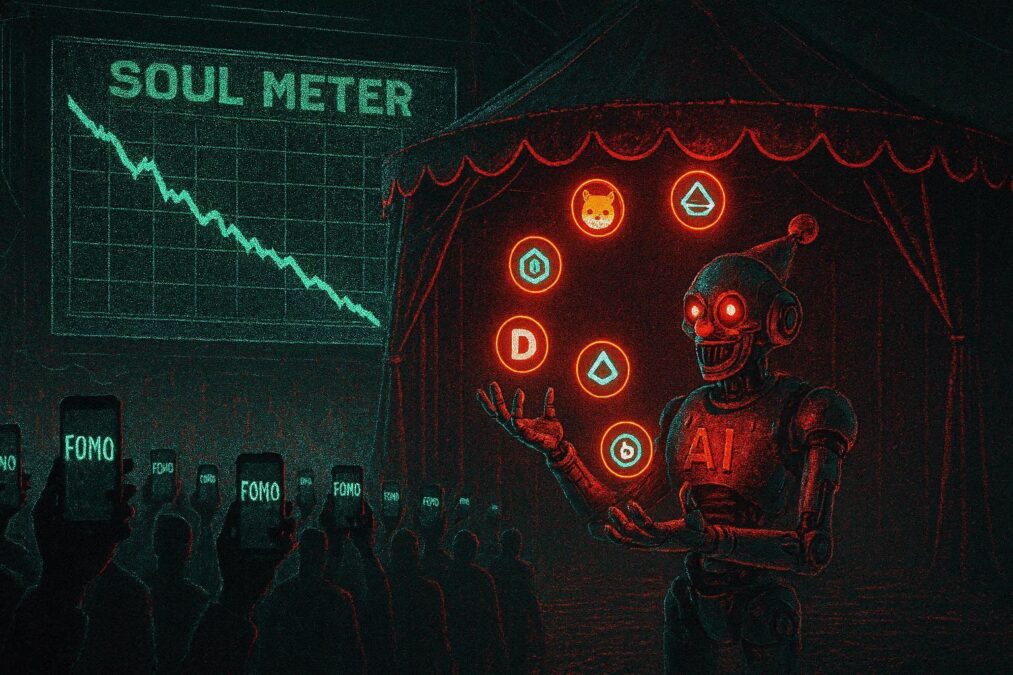
At Bitter Crypto, we focus on these fundamentals because everything else is just noise. If you don’t understand why Bitcoin exists, you will sell it the first time the media tells you it’s “dead” for the 500th time. You will be tempted by “faster” coins or “prettier” marketing.
But Bitcoin doesn’t have a marketing department. It doesn’t have a CEO. It doesn’t have a headquarters you can raid. It is a protocol. It is a discovery, much like the discovery of mathematics or the laws of physics. You don’t “fix” Bitcoin; Bitcoin fixes you. It forces you to have a “low time preference”—to stop thinking about what you can buy today and start thinking about how you can preserve your freedom for the next thirty years.
Conclusion: The Exit is to the Left (of the Central Bank)
The Bitcoin Standard is about opting out of a system designed to fail. It is about realizing that the “Safety” of the legacy world is a facade. The banks are leveraged, the governments are broke, and the currency is a melting ice cube.
Bitcoin is the bitter pill that the world needs to swallow to cure the sickness of debt-based finance. It’s hard to swallow because it requires personal responsibility. There is no “customer service” number to call if you lose your keys. There is no “undo” button. It’s just you, your math, and your sovereignty.
Welcome to the standard. It’s a long road, but at least we know where it leads. While the rest of the world is busy arguing over which flavor of fiat-flavored poison they prefer, we’ll be over here, stacking sats and watching the hallucination dissolve.